
Tag Archive for: Blue Economy

The Invisible Infrastructure of the Blue Economy

Written by Lidia Slawinska

Written by Lidia Slawinska, Communications Manager – Escola Europea Intermodal Transport

When we think about ports, the images that come to mind are often physical ones: cranes moving containers across terminals, vessels docking along quays, trucks and trains carrying cargo inland. For centuries, maritime logistics has been defined by these visible infrastructures—steel, concrete, and water routes connecting continents.

Yet today, much of the real infrastructure that makes global maritime trade possible is no longer visible.

Behind the movement of ships and cargo lies a rapidly expanding layer of digital systems, shared data platforms, and collaborative networks. These systems do not move containers directly, but they increasingly determine how efficiently, safely, and sustainably those containers move through the global supply chain. In other words, the digital blue economy is building a new kind of maritime infrastructure – one that exists largely in the background, but increasingly shapes the way ports function.

Ports as Information Hubs

Modern ports generate enormous volumes of data. Vessel arrival times, cargo documentation, terminal operations, customs procedures, and hinterland transport movements all create information that must be coordinated among multiple stakeholders.

To manage this complexity, many ports have developed Port Community Systems (PCS) – digital platforms that allow port authorities, shipping companies, freight forwarders, customs agencies, and logistics operators to exchange information in real time. According to the World Bank, these systems act as collaborative digital environments that streamline communication and coordination between the many actors operating within a port ecosystem.

The impact can be significant. By centralising and standardising information flows, PCS platforms reduce paperwork, accelerate decision-making, and improve visibility across the supply chain. They transform ports from places where information is fragmented into integrated digital hubs.

In many ways, this invisible infrastructure is becoming just as important as the physical one.

From Terminals to Digital Ecosystems

The digitalisation of ports is part of a broader transformation taking place across maritime logistics. Researchers increasingly describe this process as a systemic shift in the way port logistics are designed and coordinated, driven by data integration and digital technologies embedded across supply chain operations.

Leading ports around the world – from Singapore and Rotterdam to Los Angeles – are now developing what are often referred to as “smart port ecosystems.” These combine automation, artificial intelligence, data integration, and digital platforms to improve operational efficiency and resilience.

But the most important change is not technological alone. It lies in how these systems enable collaboration.

Ports are complex environments involving public authorities, shipping lines, terminal operators, logistics companies, and transport providers. Digital platforms allow these actors to share operational data, coordinate schedules, and anticipate disruptions in ways that were difficult to achieve just a decade ago.

In this sense, the digital blue economy is not simply about installing new technologies—it is about creating shared information environments that support collective decision-making across the maritime ecosystem.

A Growing Sector

The importance of these developments becomes clearer when viewed within the broader context of the blue economy.

According to the European Commission’s EU Blue Economy Report, maritime sectors – from transport and shipbuilding to renewable energy and coastal tourism – represent a significant economic ecosystem within Europe. Established blue economy sectors alone employed around 3.6 million people across the EU in recent years, highlighting the scale and economic relevance of these activities.

Within this landscape, ports play a central role as gateways between maritime and land-based logistics systems. As digitalisation advances, their ability to manage data, coordinate stakeholders, and integrate technologies will increasingly determine how competitive and resilient maritime trade networks become.

In other words, the digital layer supporting port operations is no longer optional – it is becoming foundational.

The Human Element Behind the Digital Port

Despite the technological emphasis often associated with smart ports, digital transformation is not simply about installing platforms or adopting new tools.

Successful digital ecosystems depend on people who understand how to use data, interpret complex systems, and collaborate across institutional boundaries. Governance structures, shared standards, and trust between stakeholders remain essential elements of any digital infrastructure.

Technology can connect systems, but it is collaboration that allows them to function effectively.

This is perhaps one of the most important lessons emerging from the digital blue economy: innovation in maritime logistics does not happen in isolation. It happens when ports, companies, and institutions work together to build shared environments where information can move as freely as cargo.

Seeing the Unseen

The cranes and vessels will always remain the most visible symbols of maritime trade. But increasingly, the efficiency of ports depends on something less tangible: the invisible architecture of data, platforms, and collaboration networks operating behind the scenes.

As maritime logistics continues to evolve, the challenge will not only be to invest in physical infrastructure, but also to strengthen these digital foundations.

Because in the ports of the future, the most important infrastructure may be the one we cannot see.

Sources

Don’t just take our word for it – explore the sources shaping this conversation:

Editorial note
This article was developed with the assistance of AI-based writing tools and verified against the sources listed above.

Innovative perspectives for training of the new generation in the Blue Economy

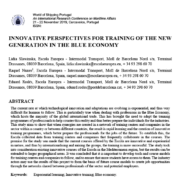
In 2019 the Escola’s team has decided to take it upon themselves to carry out a research study on the current state of experiential training offers in the areas in which the Escola is active. This study was borne out of the recognised need to understand the exponential changes that are happening in the world of transport in light of the fourth industrial revolution. This is particularly true when dealing with professions in the Blue Economy, which hosts the majority of the global international trade. The Escola’s team hoped to conclude that there is a rapidly growing need to adapt training programmes of professionals hoping to enter the maritime world, to help counter this reality and thus better prepare the individuals for the industries.

The resulting study showed that when synergies are created in a network of training centres and companies in the sector within a country or between different countries, the result is rapid learning and the creation of innovative training programmes, which better prepare the professionals for the jobs of the future. Using data data collected from training centres and companies that frequently collaborate in the Escola’s courses, the team concluded that the courses offered by the Escola have a format that is both innovative and experiential in nature, and thus by internationalising and mixing the groups, the training is more successful and current to the needs of the market. It is important to develop tools and course models for training centres and companies to follow, and to ensure that more students have access to them. The final paper can be downloaded from the Escola’s website.

At the end of November, the Escola’s team then travelled to Portugal to present the findings at the first annual World of Shipping International Conference on Maritime Affairs, which took place in Carcavelos between the 21st and the 22nd of November. During the conference topics such as improved waterborne transport concepts, energy efficiency and emission control in waterborne transport concepts, optimisation of transport infrastructure including terminal, the port of the future, the autonomous and unmanned vessels, complex and value – added specialised vessels, and digitalisation were covered in other studies presented by scientists, researchers and industry professionals from around the world. The conference, which had its pilot event this year, aims to establish itself as a meeting point of reference bringing together the industry, leading academic scientists, researchers and research scholars to exchange and share their experiences and research results on all aspects of maritime transport to promote a better future for the industry.

Check out the Escola’s paper here: https://escolaeuropea.eu/wp-content/uploads/2019/12/WofS_061_Full_Paper_FINAL.pdf.

Interested to know more? You can contact the article authors to enquire about the study itself or any future research planned.