Tag Archive for: Mediterranean ports

Barcelona, the gate to Europe and the Mediterranean

The Port of Barcelona will lead, from 9th until 17th November, a trade mission to Viet Nam. The delegation, integrated of companies importing and exporting, logistics and port will visit two major cities: the capital, Hanoi, and Ho Chi Min, which concentrates the largest commercial activity in the country.

Viet Nam was chosen by the port community of Barcelona for being considered as a strategic market, in addition for being the country that presents the greatest growth of Southeast Asia, and the second of all far East. It is seen by these companies as a stable country that is developing an ambitious reform plan to promote the internationalization of its economy.

Strategic location, productivity, quality and connectivity

Barcelona is presented to Vietnamese companies as the South Gate to access the European market and the platform of distribution for the Mediterranean and North Africa. It is the capital of Catalunya, the most dynamic region of Spain and one of the four industrial engines of Europe. Its economy, which presents a high degree of openness, represents 20% of the whole of the State, while exports exceeded 30% of the Spanish total.

El Port de Barcelona, which currently offers 5 regular maritime lines that connect it with 18 Vietnamese ports, offers a complete range of logistics solutions and reliable transport of importers and exporters highly competitive. It is of one of the ports with the highest productivity in Europe, technologically advanced and with an excellent quality of service. Likewise, has an excellent maritime connectivity, interoceanic lines of high capacity with America and Asia, and daily services of short sea shipping to Italy and North Africa. The Port – located just 160 kilometers from the French border- also has regular rail services to the Iberian Peninsula and Europe and offers customers complete logistic services prepared for serve any kind of merchandise and transport.

This commitment to quality and efficiency has led to position itself as the European port with a higher growth of traffic in the year 2017, with 61 million tons (+ 26%) and 3 million TEU (+ 32.3%). Traffic between the Port of Barcelona and Vietnamese ports also has had an excellent evolution: On year 2017, the container traffic of Catalan infrastructure with origin or destination in Viet Nam outpointed the 27,300 TEU, which is an increase of 19% over the previous year. With regard to the volume of tons, trade amounted last year to 362.412 tons, an increase of 18.5%. This positive trend is being maintained in early 2018 and, between January and June, container traffic between the Port of Barcelona and Viet Nam has increased 34%.

Catalan Viet Nam exports increased in 2017 for the third consecutive year to exceed 121 million euros, 27.3% more than the previous year. Coffee, machinery, textiles, food and furniture are among the main goods exchanged between Barcelona and Viet Nam.

Business mission of the Port of Barcelona: a model of success

Viet Nam welcomes the 20th mission business of the Port of Barcelona, which has been organized with the collaboration of the Generalitat de Catalunya, VOCI, Foment de Treball Nacional, PIMEC, Casa Asia, the Institute of foreign trade of Spain, the Embassy of Viet Nam in Spain and VISABA. In this edition, the Catalan delegation will be chaired by the Minister for territory and sustainability (Minister of infrastructures), Damià Calvet and the President of the Port of Barcelona, Mercè Conesa.

The missions aimed at strengthening business and institutional links between the port and logistics communities of Barcelona and of the receiving countries, generating new business opportunities and contributing to the internationalization of their economies.

In both cities Hanoi and Ho Chi Minh, business meetings will be celebrated. In addition, a technical seminar of customs will be held in Ho Chi Minh, which has been particularly valued by participants in previous missions.

The technical seminar of customs, which will count with the participation of representatives of entities linked to the port-logistics sector and of responsible for the customs services of both countries, will deal with those innovations that can improve the customs management in the Port of Barcelona – the figure of the economic authorized operator, the expansion of the functions customs related, telematization of document processes, etc.- and the specificities of the customs system of Viet Nam.

Subsequently, the participants will benefit from an agenda of bilateral contacts aimed at the development of new business.

Nineteen previous editions, which have visited countries of America, Asia and Africa, have been particularly valued by participants since they have generated significant growth in traffic and they have been the starting point for various Professional and Institutional collaborations that have been consolidated over the following years.

Custom contacts agendas

The Organization of the mission offers Vietnamese companies the possibility of preparing a personalized agenda of contacts, in accordance with their interests and objectives, to facilitate the detection of counterparts and business development. These agendas are being prepared by the ICEX – Office for economic and commercial of the Embassy of Spain in Viet Nam.

Source: Port de Barcelona News

Southern Europe is close to the goal of moving 40% of container traffic

The historic gap with the northern ports begins to fade.

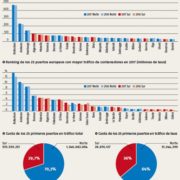
The ports of Southern Europe are moving towards a rebalancing of traffic with Northern Europe. The old aspiration of the main ports of the Mediterranean to reach the quota of 40% of the European maritime market is still distant in terms of total traffic, but it took a major a step forward in the container market. The index of the 25 European ports with the most movements in TEUs in 2017 has 14 enclaves from the South of the continent, which account for up to 36% of container traffic. A significant percentage if we assess that three years earlier this percentage was only 25%.

The same analysis of the evolution of the total port traffic dilutes the contribution of the southern ports to a percentage lower than 30%. At the same time, the number of ports of this facade in the ranking of the top 25 of the continent is limited to ten. Regardless, the index also shows a positive evolution in the South of Europe, as the first 15 ports show a growth of 4.3% in 2017, almost double that of the 15 largest ports in the North, which showed a 2.3% increase.

Despite this, this growing trend of southern European ports coincides in a context of growth for the giants that make up the axis from Le Havre to Hamburg, historical leaders of maritime traffic on the continent. Rotterdam continues to increase its dominance in the European ranking, with a growth of 11% in 2017 in the container segment, reaching 13.7 million TEUs moved through its docks; while Antwerp achieved a 4.1% growth in 2017, with 10.4 million TEUs.

Hamburg was the exception, losing 1% of traffic, with 8.8 million TEUs; while Bremen achieved a slight increase of 0.9% by processing 5.5 million containers last year.

After these first four positions, European container traffic moved to Spain, which in 2017 holds three enclaves within the continent’s elite. The results at the end of the year show that the port of Barcelona joins Valencia and Algeciras in the European top 10, after registering a spectacular growth of 32.2% in number of TEUs transported in 2017, the largest percentage increase of the entire European port system with almost three million units. The Catalan enclave recovers the position that it occupied in 2007, before the economic recession, and now the number of moved TEUs is almost 14% higher than that registered that year.

For its part, Valencia increased its traffic by 2.1%, to 4.8 million TEUs, and snatched the fifth place from Algeciras, with 4.3 million TEUs and a sharp decline of 7.9%, due, among other factors, to the stowage conflict, which affected the Andalusian port more than other Spanish enclosures. It also highlights the growth experienced by another Mediterranean port, the Greek port of Piraeus, which transported more containers than in 2016, grew a 10.5%, and surpassed the figure of four million containers.

More growth in the Mediterranean

Expectations for 2018 also point to the fact that this growth will continue in the ports of Southern Europe, according to the latest Global Port Tracker report prepared by Hackett Associates. According to the forecasts offered by this maritime consultant, in 2018 there will be an increase of 6.2% in total imports to Europe, with 25.7 million TEUs. Specifically, it expects Northern Europe to increase its traffic by 5.6%, to 16.06 million TEUs, while pointing out that the Mediterranean and the Black Sea region will achieve a rebound of 7.2%, with a prediction of 9.64 million containers.

For its part, the forecast of exports made by Hackett Associates for the year 2018 projects an increase of 5.8% for Europe, with a total of 22.11 million TEUs, with Northern Europe increasing by 3.7%, reaching 13.66 million containers; while the Mediterranean and the Black Sea regions will achieve an increase of 9.4%, transporting up to 8.44 million units.

Overall, according to the calculations offered by the consultancy, the Northern ports would accumulate a total volume of 29.7 million containers in 2018, reducing their quota to 62.1%; while the southern enclaves of the continent are expected to achieve a total of 18 million TEUs, increasing their participation to 37.9%, which would confirm the upward trend of the growth of these ports in recent years.

Hacket Associates’s report places the port of Hamburg as the main victim throughout 2018, “affected by the reduction in transshipment services to the Baltic and the fierce competition of Rotterdam.”

Source: El Vigía
European ports support community plans to reduce emissions in maritime transport

Port facilities, coastal cities and their local communities are among the groups most vulnerable to extreme climatic conditions resulting from global warming.

The International Maritime Organization, IMO, will adopt its initial strategy for the reduction of greenhouse gases during the month of April in the Committee for the Protection of the Marine Environment. For this purpose, the setting of a limit for the reduction of CO2 emissions in the short term and other measures in the medium and long term will be discussed.

Once adopted, this strategy will be combined with other national measures to test their effectiveness and alignment with the objectives of the Paris Agreement to combat global warming.

This is required by the European Union, which has recently agreed on its position on these negotiations and has the support of the European Sea Ports Organisation  (ESPO). In this sense, they expect their opinions to be taken into account in the negotiation as a constructive contribution.

Under the Paris Agreement, all countries and economic sectors must initiate immediate actions to maintain the temperature rise below 2 °C, although ports, coastal cities and their local communities are among the groups most vulnerable to theclimatic extreme conditions that result from global warming.

Both the measures proposed by Brussels and by the EU countries to achieve this goal require ports to reduce the carbon footprint of their terrestrial activities. In parallel, European ports aim to achieve the decarbonisation of maritime transport through a range of sustainable services.

In this line, the European Directive for the infrastructure of alternative fuels determines that the ports of the TEN-T network should by 2025 have adequate facilities for the bunkering and supply of LNG fuel by means of power supplies in their enclosures.

Source: Cadena de Suministro